 |
|
|
|
|
Click on a Photo or Letter below for details
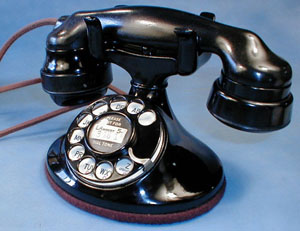
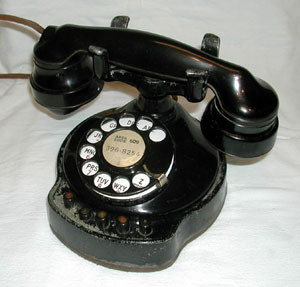
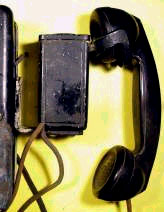
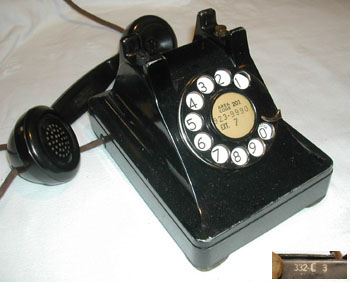
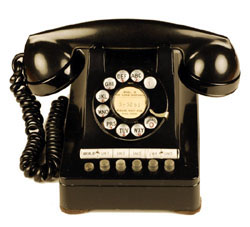
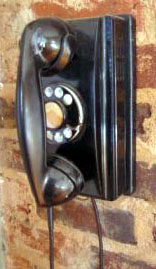
| Mounting Code: A
B C D E G
H
S AA AB J L M Imperial GN4676 Table of Mounting Codes used in 100- and 200-series telephone sets |
|
This
page provides general identification information
on the major Western Electric handset mounting
types, focusing on types A thru G.
Handset mountings were introduced in the mid-1920s. Their purpose was to provide the mechanical structure to hold a handset, line switch, optional dial and provide cord terminations. The handset mounting with switchhook, handset, cords, plus a dial or apparatus blank was termed a "hand telephone set." To make a complete telephone, the hand telephone set was wired to a "subscriber set" (subset), which included a coil, capacitor and ringer. The subset was in a box that could be conveniently mounted near the hand telephone set on the wall or side of a desk. Handset mountings coded A thru G were used in hand telephone sets with model numbers in the 100- and 200-series. Later handset mountings were used in so-called "combined sets," where all the components, including the subset, were integrated into one package. Most early telephones in the 300- and 400-series had mounting codes, while some of the later models did not. Telephone sets beginning with the 500-series did not use handset mounting codes. Handset mountings have several variations with suffix numbers and letters to denote different terminal, switch and wiring arrangements. See the catalogs or BSPs for details. There are undoubtedly more BSP references to be found. The table below shows photos for each handset mounting in a complete telephone, along with a brief description, list of representative telephone sets that use the mounting and some BSP references, to help with your research. Note that the model numbers in the 100 and 200 series telephones include the wiring characteristics and all components of the phone including the subset and cords. Models such as the 102, 103, 104 and 202 can be be wired with appropriate A, B or D mountings . Therefore the model number can not be readily identified without a close inspection of the subset type and wiring. For example, a 102 does not always include a B1 mounting. It can use an A1 or D1 mounting instead. Similarly, a 202 can be wired using an A, B or D mounting. Therefore, it is generally preferable to use the mounting code letter when identifying a phone, unless you are certain of the subset type and how the phone is wired. (e.g. use A1, B1 or D1 -- not 102 or 202) Color information is on the page "Phones in Color!" Handset types are on the page "Western Electric Handset Styles" Follow links where available to detail pages highlighting the major variations. This is a work in progress. Please send comments, additions and corrections. |
| Photo |
Description
&
Marking |
Common Uses |
BSP/ Catalog |
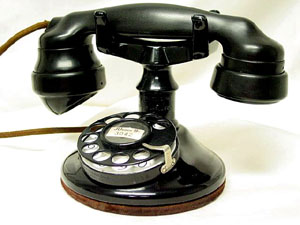
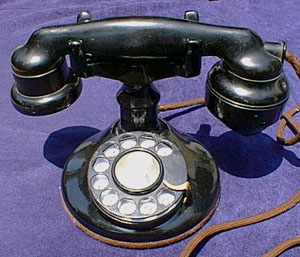 A-type with A handset A-type with E handset |
WE A
Handset Mounting Manual set uses 50D apparatus blank. 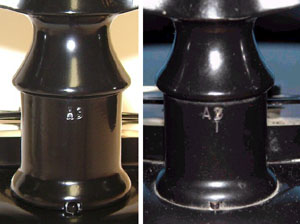 Marked A3 on back - and - converted from A3 to A1 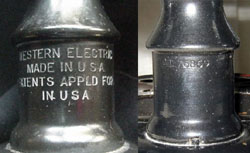 Many are marked D76869 on back Some early E1 handsets on A mountings may be marked D-80370. NOTE: The common variation is the A1. For some reason, it is often referred to as an AA1 - an error that has been propagated in a popular collector reference book. Western Electric references we have seen call it an A1, or possibly an A1A when mated with a proper subset. There is a set with a mounting code of AA1, but it's in the 300-series. Check it out here: http://www.paul-f.com/we300typ.htm#AA1 |
Hand Telephone Sets 102 103 104 202 |
ATT Spec 4810 (Dec '27) C32.301 C32.375 C32.060 C32.160 C32.161 |
 B-type with E handset B-type, manual |
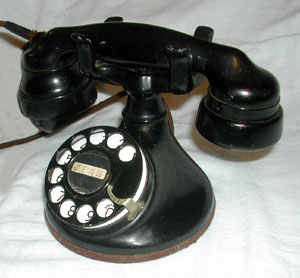
WE B Handset Mounting Replaced the A-type mountings. Manual set uses 50H apparatus blank. Marked "B" and a number on the back just below the cradle. |
102 103 104 202 203 |
ATT Spec 4810 (Dec '27) C32.101 C32.301 C32.375 C32.060 C38.403 to C38.431 -sidetone- C32.160 C44.101 -antisidetone- C32.161 C44.102 |
 C-type with 39A dial mounting and dial |
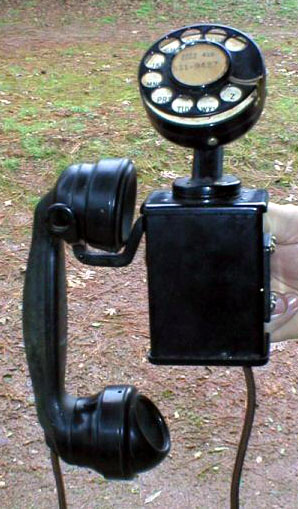
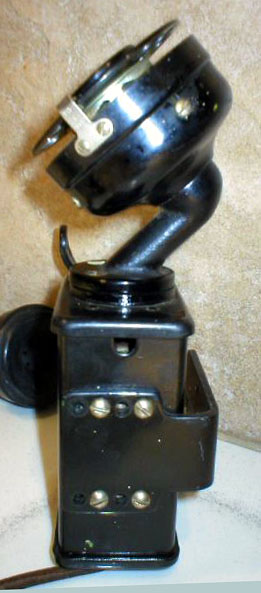
WE C Handset Mounting Rectangular cross section. Manual set uses a card holder in place of the dial mounting. Mounts on wall or side of desk or counter, using a simple L-shaped bracket.. Marked "C" and a number on the main housing. |
101 201 |
ATT Spec 4810 (Dec '27) C32.301 C32.375 C32.060 -sidetone- C32.102 C32.160 C44.101 -antisidetone- C32.103 C32.161 C44.102 501-160-100 |
|
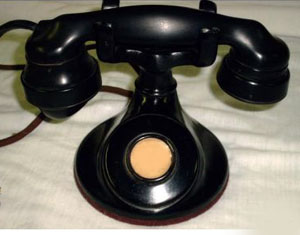
WE D Handset Mounting Replaced the B-type mountings. Manual set uses a 50J apparatus blank. Elliptical base for better stability when dialing and aesthetics. Recessed dial requires a #4 or later dial. Marked "D" and a number on the back just below the cradle. See more photos below. |
102 103 104 202 203 206 207 215 |
C32.111 C32.301 C32.375 C32.060 C38.403 to C38.431 -sidetone- C32.102 C32.160 C44.101 -antisidetone- C32.103 C32.161 C44.102 |
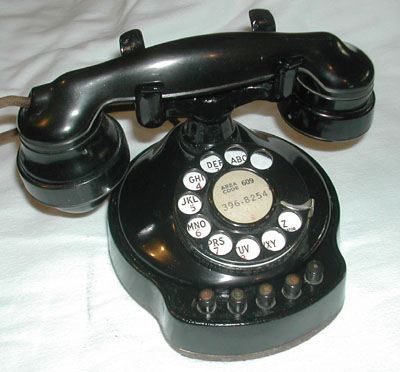 E-type with E handset 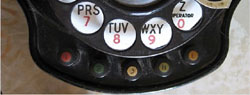 E4 keys marked 1 2 3 H L E7 keys marked H 1 2 3 L 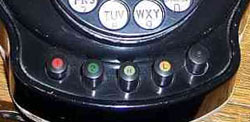 E5 keys marked 1 2 H L B H for hold L for local intercom line B for code ringing (buzzer) |
WE E
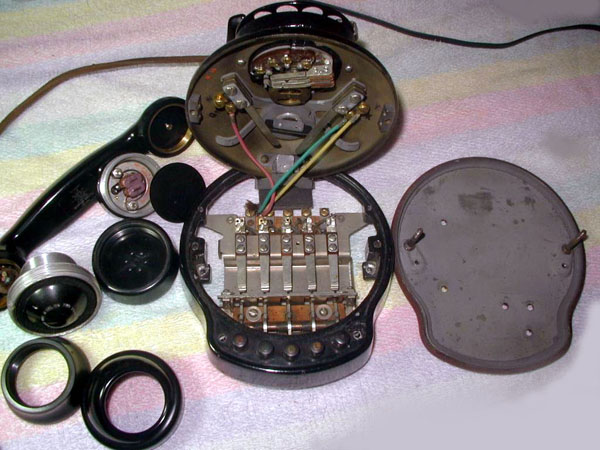
Handset Mounting Multi-line keyset with controls for hold and local intercom. Functions are supplied by an external equipment cabinet. See internal details below. Marked "E" and a number on the back below the cradle. (The neck shape is different than the A, B or D mountings.) 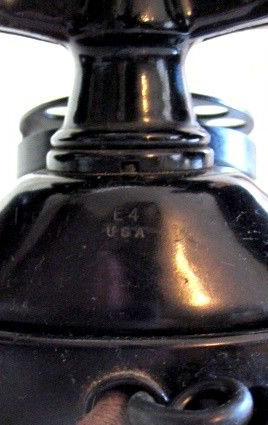 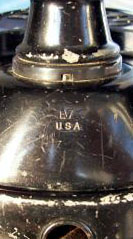 E4 replaced by E7 for
businesses.
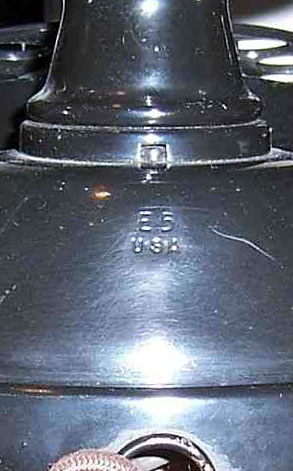 E5 for residences.
|
105 205 208 |
C32.111 C32.301 C32.375 C32.060 -sidetone- C32.102 C32.160 C44.101 -antisidetone- C32.103 C32.161 C44.102 |
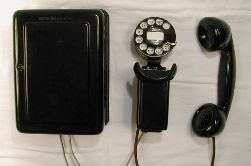 G-type with subset and F handset 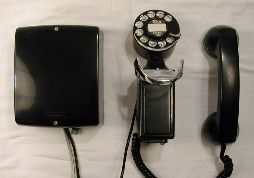 G-type with subset and G handset |
WE G Handset Mounting Square cross section. Manual version has a card holder in place of the dial mounting. Early 41A dial mounting was replaced by the 43A adjustable dial mounting. Marked "G" and a number, usually below the cradle. See more photos below. |
211 212 213 214 |
C38.323 to C38.473 501-160-100 |
For more info on variations of the sets below, see the WE 300-series page or follow links to specific models. |
|||
|
WE H, S, AA and AB
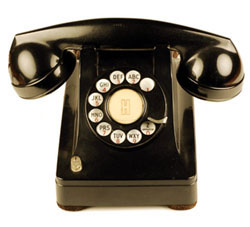
Handset Mountings Used on 300-series desk telephones. Usually marked with mounting code letters and a number on the inside of the housing near the rear cord hole. Some metal housings marked outside the rear cord hole. |
300-series |
C38.545 to C38.579 |
 |
WE J Handset
Mountings Used on 400-series keysets with twist keys. Usually marked "J" and a number on the inside of the housing near the rear cord hole. |
410 411 |
C38.591 to C38.594 |
|
WE L Handset
Mountings Used on 400-series 4- and 6-button keysets. Usually marked "L" and a number on the inside of the housing near the rear cord hole. |
44x 46x |
C38.591 to C38.594 |
|
WE M Handset
Mountings Used on 300-series wall telephones. Usually marked "M" and a number on the inside of the back plate. |
35x |
C38.575 C38.577 |
| Telephones after the
300/400-series do not use mounting codes. |
|||
| Other D-type
mounting uses |
||
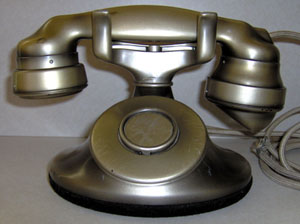 D-type in Bronze Paint A list of other colors is found here: "Phones in Color" |
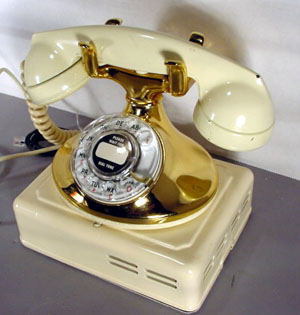 D1 Imperial Refurb model released in mid-1950s. One of several attempts to increase the lifespan of the D-type by creating an "upscale" nostalgic re-release. Shown sitting on subset, which was mounted on the wall or desk side. Compare with the GN4676. Similar Continental models were made with bases painted in standard colors. and matching handsets. For colors: "Phones in Color" |
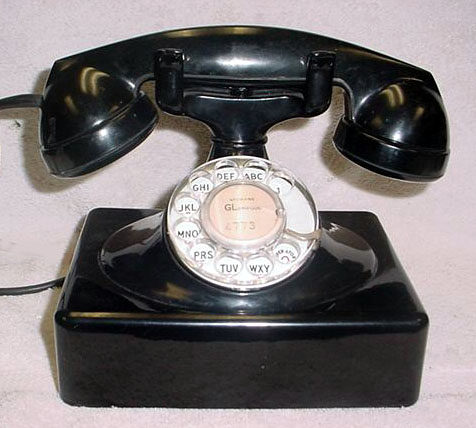 D1 as part of the GN4676 Refurb model released in mid-1950s Most found sets are dated in mid-1955. F4 handset. Uses a new cover on a 684A subset with a recess to hold the D1 firmly attached to the subset. Metal and plastic covers have been found. Read more in TCI's Singing Wires Aug 2018: The GN4676 “Metropolitan” Telephone And Other Uses for Recycled D-type Mounts by Paul Fassbender Feb 2021: WE GN4676 “Metropolitan” Found in Seattle by Russ Kirk |
| Other
G-type mounting uses |
|
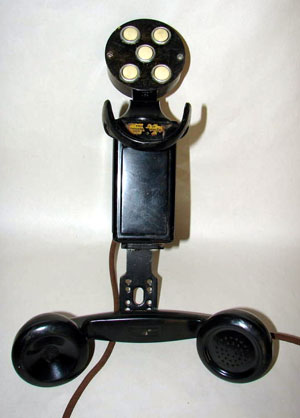 G-type used as an intercom station Pushbuttons used to signal other stations |
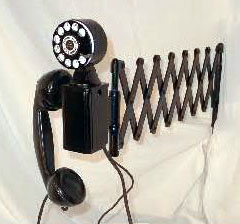 G-type on a scissors mount |
|
A
thru G mountings used in 100- and 200-series Model
Numbers
The three character model number for a "hand telephone set" included the handset mounting with switchhook, handset, wiring and cords. A suffix letter specified a dial with number plate, or an apparatus blank. An appropriate subset was required to make a complete telephone. [Under Construction -- Compiled from several sources. Please send additions and corrections.] Best viewed on a PC or Tablet. 100-series: sidetone circuit 200-series: anti-sidetone
|
|||
Hand Telephone Sets (bracket-mount for wall or desk side) 101 - (C1), E handset *, sidetone, 201 - (C1), E handset, anti-sidetone, 211 - (G1,G6,G8), F handset, 212 - (G2), F handset, 2 party selective message rate party-on-tip, 213 - (G3), F handset, for 755A PBX, 214 - (G2,G7), F2 handset, with 23A amp for hard of hearing, |
Cradle Telephones (desk) A1A - (A mounting), round base, E handset * - A1-A7 D76869 B1A - (B mounting), round base, E handset 102 - (B1,D1), E handset, sidetone 103 - (B2,D2), E handset, sidetone, 4-party line 104 - (B3, D3), E handset 202 - (B1,D1), E handset, anti-sidetone 203 - (B6,D6), E handset, anti-sidetone, 4-party line 204 - (B3,D3), E handset, 8-party 206 - (D5-early, D10-later), E handset 207 - (D3), E2 handset, amplified for hard of hearing 215 - (D8), E handset 105 - (E4) round base business keyset 205 - (E4-early, E7-later) round base business keyset 208 - (E5) round base residential keyset |
Model Suffix Examples (anti-sidetone) Manual (non-dial) telephone sets: 202A - (B1 or D1 hand set mounting) 202H - (B1 or D1) 204A - (B3 or D3) 206A - (D5) 207A - (D3) 208A - (E5) [1933 BLR, 4/33] 215A - (D8) With dial: 202B, 202C, 202D - (B1 or D1) 202E, 202F, 202G - (B1 or D1) 203A, 203B, 203C - (B6 or D6) 204B, 204C, 204D - (B3 or D3) 205A, 205B, 205C - (E4) [1930 BLR, 2/30] 205D, 205E, 205F - (E4) 205G, 205H, 205J - (E7) 206B, 206C, 206D - (D5) 206J, 206K, 206L - (D5) 206M, 206N, 206P - (D10) 207B, 207C, 207D - (D3) 208B, 208C, 208D - (E5) 215B, 215C, 215D - (D8) |
|
| See the Bell System Practices
for each model for more details and variations. (Find some
BSP numbers in the table above.) BSP, Section C32.111, Issue 2, Dec 1932, Hand Telephone Sets, Desk Types, Description * Note: Issue 3, June 1953 shows F-type handsets replacing E-type handsets, change to 6-type dials and eliminates sidetone set references. These Cording BSPs show A, B and D mounts used interchangeably for 100- and 200-series sets. C32.160, Issue 1, Nov. 1931 - Sidetone Hand Telephone Sets - CordingAddendum C32.164, Issue 3, July, 1953 includes the following: [Sidetone sets are no longer listed (102 etc).] 103A, 103B, 103C---D2 or B2C63.333, Issue 1, May, 1955 -- Hand Telephone Sets--Desk Type--Connections shows: 202 and 215 can be used with sidetone subsets (534 or 584) as well as anti-sidetone subsets (684 etc).Much more info is available in the TCI Library. Here is a good starting point: https://www.telephonecollectors.info/index.php/browse/bsps-bell-system/most-popular/c32-telephone-sets |
|||