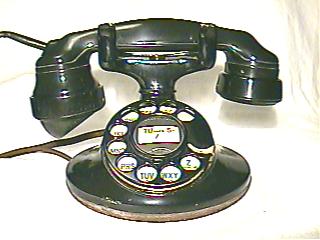
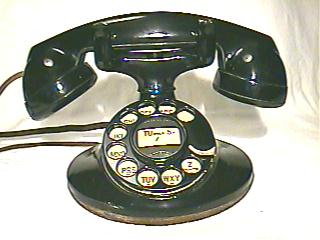
with F1 handset
Oval shaped metal base was designed to accommodate the E1
handset and a recessed dial. Available with or
without dial. Designed to be used with an external
subscriber set (not included - phone set up for
display).
Price: $275. E1 handset.
$250. with F1 handset, as shipped with later production units.
To make it a working phone, either may be connected to an
optional external ringer box ($40-100), or an internal
modern network ($25) to interface with the phone
line. Email for details.
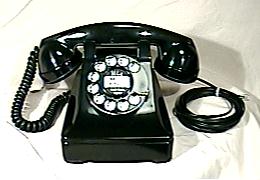
The first WE phone with the network and ringer built into
the phone. Originally introduced with a metal base and the
new "F1" handset, World War II forced a switch to
thermoplastic bases in 1941. Works great on modern phone
lines.
Price: $150, Plastic case.
$200, Metal
case.
Occasionally available in ivory thermoplastic
with clear fingerwheel.
Price: $300-400.
Other variations include a model with a ringer on/off
switch on the front and a 2-line model.
(For more info on the WE 300-series, click here.)
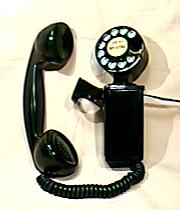
211 with F handset for display only
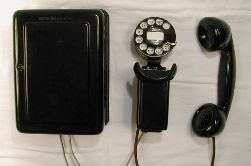
211 with F handset and metal subset
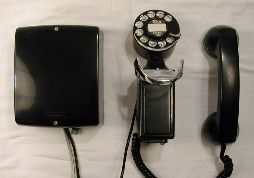
211 with G handset and plastic subset
Designed to fit into tight places, this unit was often found in workshops, bars, retail stores, attached to the side of a desk to preserve desktop space, and was briefly marketed as a wall phone for home use.
The "handset mounting" (top photo) only contains a hookswitch and connection terminals. The components in the top photo are great for display, but are not a complete telephone.
To work, an external subscriber set must be added, which contains coils, capacitors and the ringer. The subset was mounted away from the phone, on a wall or under a desk or counter, saving space on the desk.
Price (without subset):
$120. Dial set with G
handset.
$135. Dial set with
F1 handset.
$80. Manual model
(without dial) with G handset.
Options include an original-style or repro angle bracket
for wall mounting.
External subset ($40-100) to interface with the phone
line. Several configurations are available, such as
the early metal subset in the middle photo or the later
plastic subset in the lower photo. Various styles of
wood ringer boxes can also be used with modern
mini-networks to make a working phone. Email for
details
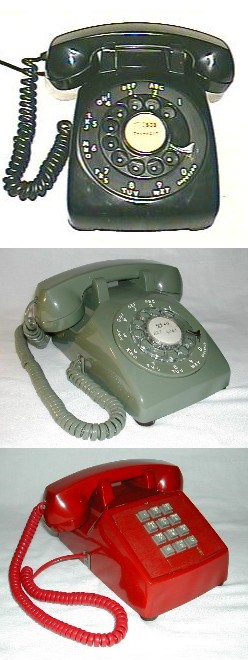
The workhorse of the WE line for many years. These are the phones most baby boomers grew up with. Originally introduced in black only with a metal fingerwheel.
Colors and clear plastic fingerwheels were added in 1953
and the range of colors was expanded in 1958. By
decree, this design was licensed to all comers, and was
made by numerous companies. Kellogg, Stromberg
Carlson and Cortelco are a few examples. The design
is still being produced by several companies today!
I specialize in the high quality US-built models made
before cost reductions that were instituted after the
break up of the Bell System in 1984.
Price: $120. Early model (made by Western
Electric in the 1950s and early 60s) in black with Metal
Fingerwheel (top photo).
Email for availability and price of other variations and colors, including both hardwired and modular versions. Popular model numbers are:
500DM - Single line rotary desk set with modular
cords (middle photo - green set)
2500DM - Single line TouchTone desk set with
modular cords (lower photo - red set)
554BM - Single line rotary wall set with modular
cords
2554BM - Single line TouchTone wall set with
modular cords
Popular colors include beige, black, green, aqua, yellow,
red and pink.
Price range: $80-150,
depending on style and color.
Well over 100 models and variations were produced by
Western Electric for the Bell System.
For more information, check out the table in my site, "Old
Telephones as Entertainment!" by following this
link: WE500 Types.
No, I don't stock them all! I do have quite a few,
though, so if you see any you like, email me for
availability.
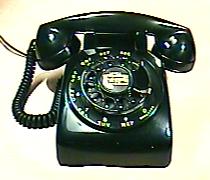
Introduced after the 500, when customers wanted the look of the new series and the phone company wanted to use up stock of the older 302 parts. Uses the base, internals and 3" dial from a 302 (often refurbished), with a special case that looks similar to the 500 but is shorter from front to back. Click for side view. The ring with letters and numbers around the dial is like that on the 500's dial. The cradle was designed to accommodate either the F or G series handsets. Was installed with one of 3 handsets -- the F1 (shown), a G handset using the F's internal elements, and the G (same as on the 500D above).
A lot scarcer than either the 300 or 500!
Price: $140. With either F or G handset.
$175. 5302 W
(without Bell System Markings)
(I have acquired a limited number of NOS [new old stock] shells, which will be installed for an additional $40.)
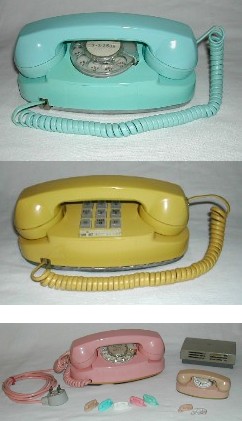
Initially marketed as a bedside extension with the
slogan,
"It's little, it's lovely and it lights."
A switch on the back controls a night light that softly illuminates the dial. When the handset is picked up, the light gets brighter for dialing. (Requires optional transformer.)
The first model (701) had no internal ringer and was so light, an optional lead weight was added to make dialing easier. The 702, introduced in 1963, includes a ringer in the base and is usually available in a variety of colors, such as beige, light blue, green, red and pink. Price depends on color chosen.
Price: $100-160, 702BM, Rotary, modular
cords.
$120-180,
2702BM,
TouchTone, modular cords.
Dial light transformer kits (wired and tested): $25
with a phone.
Also available: (Email for details.)
Sets with hardwired cords.
Early 701s with optional weight and external
ringer.
Early 10-button TouchTone sets (No * and # keys).
Princess phone keychains
in 5 original model 701 colors.
Princess mini sets,
beige (about 4" long). Used as marketing aids to
show the colors to prospective customers for a second
phone -- a radical idea in the early 1960s!
(For more info on Princess sets, click here.)
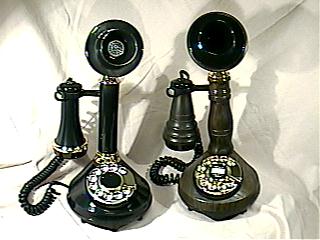
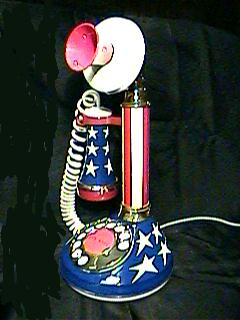
Designer phones made out of "modern" high quality
components built to resemble the candlesticks made in the
teens and twenties. Made by ATC and sold by Western
Electric, GTE and others. The straight shaft is black, the
shaped shaft is woodgrained. Cases are plastic. Some
dials have metal fingerwheels and porcelain number plates.
These are, in my opinion, of superior quality when
compared with the many other similar telephones that were
available in the 1970s and 1980s.
Price: $120, Black, red or white, straight shaft.
$140, Woodgrained, shaped shaft.
$150,
Bicentennial "Stars and Stripes".
One available with the rare "Canadian Maple Leaf" design.
Note: Some metal candlestick phones in both dial and
manual styles made from the teens thru 30s are
available. Email for details.
(For more info on Design Line sets, click here.)
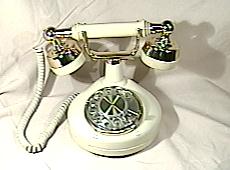
Designer phone made out of "modern" high quality
components built to resemble early European "French"
phones. Ivory with gold-colored accents and trim.
Price: $100.
Occasionally available in aqua or TouchTone.
(For more info on Design Line sets, click here.)
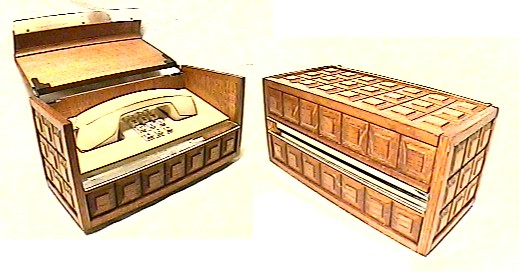
"Executive" touchtone phone in a furniture quality oak
chest. Relief panels on all five visible
sides. Stunning!
Price: $100.
Occasionally available in flat-sided walnut, rotary or
touchtone.
(For more info on Design Line sets, click here.)